

Plisio Outage Review: What Really Happened to Merchant Funds After the "Hacker Attack"?
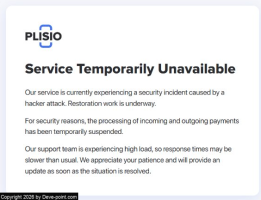
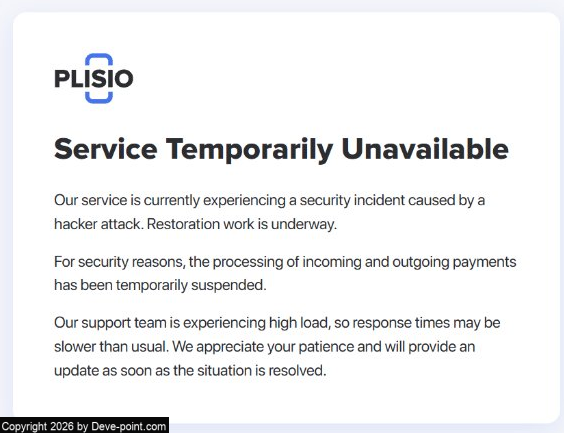
When cryptocurrency payment gateway Plisio (plisio.net) abruptly went offline and posted its brief downtime notice citing a "security incident caused by a hacker attack," thousands of digital merchants, independent store owners, and freelance developers were left with their balances frozen mid-air.
Now, as the outage drags on with virtually no transparent communication, the urgent question resonating across developer forums and Telegram channels is: Has anyone actually received their money back, or is Plisio pulling a calculated exit scam disguised as a cyberattack?

Post-Outage Reality: Did Plisio Support Respond?
Based on aggregated reports from impacted e-commerce merchants and individual wallet holders who attempted to contact Plisio support through email, live chat, and support tickets:
Did Anyone Get Their Money Back?
To date, across cryptocurrency communities, web development hubs, and merchant feedback platforms:
Transactions submitted moments before the site went down remain unconfirmed in Plisio's database, while merchant wallet balances remain locked on the server side with no ability to export private keys or broadcast raw transactions.
Legitimate Cyber Breach vs. Exit Scam: Evaluating the Red Flags
In the cybersecurity and blockchain forensics sphere, when a centralized or semi-custodial payment aggregator suffers a breach, there are clear standards that differentiate a genuine security response from an exit scam:
1. How Legitimate Payment Gateways Handle a Breach:
2. The Red Flags Exhibited by Plisio:
Immediate Checklist to Protect Yourself from Further Losses
If your website or store previously accepted payments through Plisio, follow these essential survival steps:
Community Call: Share Your Status & Help Us Uncover the Truth
We want to gather clear, indisputable community evidence to determine whether Plisio is actively working on recovery or executing an exit scam:
Drop your experience, dates, and findings in the comments below. Your input directly protects other developers and business owners from falling into the same trap.
When cryptocurrency payment gateway Plisio (plisio.net) abruptly went offline and posted its brief downtime notice citing a "security incident caused by a hacker attack," thousands of digital merchants, independent store owners, and freelance developers were left with their balances frozen mid-air.
Now, as the outage drags on with virtually no transparent communication, the urgent question resonating across developer forums and Telegram channels is: Has anyone actually received their money back, or is Plisio pulling a calculated exit scam disguised as a cyberattack?
Post-Outage Reality: Did Plisio Support Respond?
Based on aggregated reports from impacted e-commerce merchants and individual wallet holders who attempted to contact Plisio support through email, live chat, and support tickets:
- Generic Auto-Replies: Ticket creators receive automated, generic responses stating that "support is experiencing unusually high volume" and that "restoration work is underway," without providing a timeline or ticket resolution date.
- Complete Silence on Direct Inquiries: Inquiries regarding specific transaction hashes (TXIDs), manual emergency settlements, or access to private wallet keys receive zero follow-up from human operators.
- Disabled or Unmoderated Channels: Merchants attempting to seek answers through public social media channels find comments restricted or inquiries left unanswered.
Did Anyone Get Their Money Back?
To date, across cryptocurrency communities, web development hubs, and merchant feedback platforms:
من فضلك قم , تسجيل الدخول أو تسجيل لعرض المحتوى
Transactions submitted moments before the site went down remain unconfirmed in Plisio's database, while merchant wallet balances remain locked on the server side with no ability to export private keys or broadcast raw transactions.
Legitimate Cyber Breach vs. Exit Scam: Evaluating the Red Flags
In the cybersecurity and blockchain forensics sphere, when a centralized or semi-custodial payment aggregator suffers a breach, there are clear standards that differentiate a genuine security response from an exit scam:
1. How Legitimate Payment Gateways Handle a Breach:
- Transparent Post-Mortem Disclosure: Legitimate gateways immediately publish an incident summary disclosing the attack vector, affected server segments, and exact compromised wallet addresses.
- Proof of Solvency & Cold Reserve Backing: Reputable platforms reassure clients by verifying cold storage reserves and assuring merchants that client funds are backed 1:1.
- Active Communication & Periodic Status Updates: Official incident reports updated every few hours to keep clients informed of security audit milestones.
2. The Red Flags Exhibited by Plisio:
- Zero Technical Proof: No on-chain wallet addresses, no post-mortem technical details, and no proof of an external intrusion have been provided to the public.
- Complete Indefinite Freeze: Both incoming and outgoing transactions are suspended without providing merchants an emergency mechanism to claim their existing pre-incident balances.
- Holding Client Liquidity Without Timeline: Leaving merchants in complete darkness while holding significant operational liquidity is a hallmark symptom of high-risk crypto platforms nearing an exit event.
Immediate Checklist to Protect Yourself from Further Losses
If your website or store previously accepted payments through Plisio, follow these essential survival steps:
- Strictly Stop Sending Crypto to Plisio Addresses: Never deposit additional funds under any pretext (such as "fee verification" or "account reactivation"). Any funds sent now are likely gone forever.
- Beware of "Recovery Scam" Predators: Cyber scammers actively monitor forums and social media for victims of the Plisio breach, posing as "recovery agents," "blockchain ethical hackers," or "Plisio refund staff." Anyone asking for an upfront fee or seed phrase to "recover" your Plisio funds is a 100% secondary scammer.
- Preserve Legal Proof & Documentation: Capture timestamped exports of all pending invoices, store purchase logs, customer transaction hashes, and support communications.
- Switch to Established, Audited Gateways: Transition your e-commerce checkout to self-hosted open-source solutions (such as BTCPay Server) or fully regulated institutional payment processors that do not hold custody of your private keys.
Community Call: Share Your Status & Help Us Uncover the Truth
We want to gather clear, indisputable community evidence to determine whether Plisio is actively working on recovery or executing an exit scam:
- Has anyone received a reply from a human Plisio support agent?
- Did anyone manage to withdraw any cryptocurrency (BTC, USDT, ETH, LTC) since the incident notice was posted?
- How much total balance is your business currently unable to access?
Drop your experience, dates, and findings in the comments below. Your input directly protects other developers and business owners from falling into the same trap.